



Balancing Act Between Elite Sports and School
For aspiring elite athletes, balancing school with training quickly becomes a tough task. Training and competitions often push the boundaries of traditional school schedules. Sports schools, on the other hand, prioritize flexibility and self-directed learning.
Selina Müller started taking swimming lessons at age four. At seven, she joined the local swimming club. “We admired the swimming stars standing on the podium at the Olympics and World Championships,” she recalls. “For us, it seemed out of reach. We were just Swiss girls in some swimming club.” Today, Selina is 17 and ranks among the national top swimmers in her age group.
Selina attends OYM College in Cham in the canton of Zug. This school is labeled a Swiss Olympic partner school and as such is bound by the rules of this governing body for Swiss sports. Partner schools excel at creating an environment that supports elite athletes by helping them balance education, training, and social life. Currently, 63 schools across Switzerland carry this prestigious label. Additionally, Swiss Olympic operates four specialized sports schools that combine education, training, accommodations, and sports facilities in a single location. To get into one of these schools, students typically need to be part of a regional or national team. The goal is to integrate top athletic performance with a strong academic foundation.
Sports talent alone isn’t enough
OYM College in Cham currently teaches 112 young athletes playing 16 different kinds of sports. The school offers both a secondary school and a commercial vocational program. Sports talent alone isn’t enough for admission. “The applicant must also meet the academic standards and the canton’s admission requirements for the secondary school or commercial program,” Joël Fux, the school’s principal, explains. Students showing significant athletic potential have their tuition fees covered by their home canton. This means that the canton’s admission regulations apply according to the Talent Promotion Agreement.
“The key difference between the college and public schools, is the flexibility and individualized nature of the learning environment.”
Although OYM College is a private institution, it still has to adhere to cantonal guidelines just like public schools. “We are a private school with a public educational mandate from the canton of Zug,” Fux says. “Therefore, we work closely with the canton.” Zug, like many other cantons, already offers special classes for athletic talents starting at the lower secondary level.
Few students in the classroom
The key difference between the college and public schools, according to Fux, is the flexibility and individualized nature of the learning environment. “We don’t have homeroom teachers,” he emphasizes. Instead, the college provides a team of subject specialty teachers composed of learning and personal coaches. Fux adds: “Each specialist supports a group of students individually.” Digital and self-directed learning are at the core of the program. Because students often miss class due to training or competitions, there are usually only a few students in the classroom – others learn on the go or from home.

Admission to the college isn’t based solely on sports and academic talent but also on practical considerations. If the training facility is too far away or the commute is too long, attending the college may not be practical. About half of the athletes train directly at the OYM training center. The college also recently introduced a boarding option: A separate residential complex allows students to balance school, training and daily life.
Morning training without stress
On Thursday mornings, swimmer Selina usually arrives an hour late for class because, at this point, she has already completed her first training session. “For athletes at public schools, morning workouts are often really stressful,” she says. “If they leave the pool or gym just 10 minutes late, they already miss a big part of the first lesson.” It’s even more stressful if they are barred from participating in competitions because they’ve missed school for many days.
Flexible learning requires flexible teachers
For Selina, skipping a lesson or missing a school day isn’t a big deal. At OYM College students incorporate absences into their schedules with complete transparency. Learning coaches remain in the loop and all lessons are available online. Students are expected to catch up on missed material on their own. The school combines freedom with responsibility and discipline. “We follow the ‘get-it-yourself principle,’” Olivia Greub, a learning coach, explains. “Students know where to find the content and support they need. It’s up to them to seek it out. That’s what makes our system different from traditional schooling.” Teachers must adjust as well. Every lesson is designed to work both in class and online. Teaching sequences are recorded on film and teachers carefully monitor the students’ progress.
“As a learning coach, I need to know exactly where each student stands – even if they haven’t been physically present in class for weeks.”
Students with fierce athletic ambitions keep teachers on their toes just as much. “As a learning coach for biology and chemistry, I need to know exactly where each student stands – even if they haven’t been physically present in class for weeks,” Greub says. A team athlete who spent two weeks at a World Championship in Canada is at a different point in their learning than an athlete taking a break from the season in Cham. Greub finds the students’ determination, discipline, and endurance impressive. “Sports is always their top priority,” she says. “Everything else takes a backseat to that.” As a coach, her focus is different: “Our job isn’t just to see the students as athletes but above all as people and learners.”
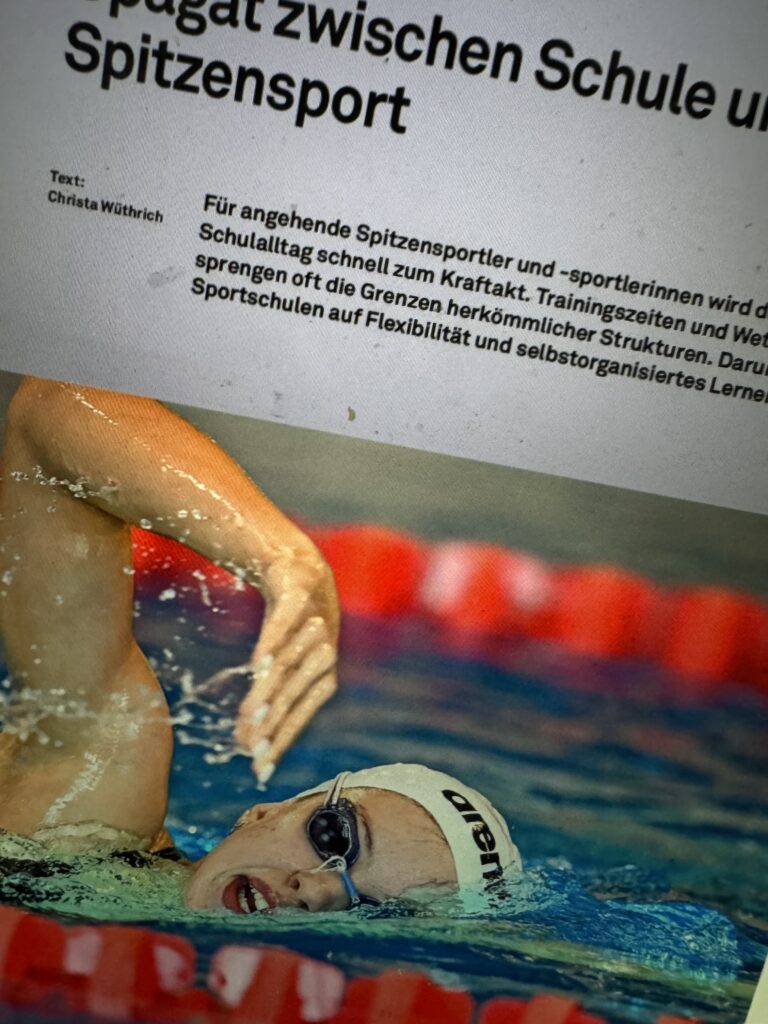
Do these sports talents have any time off from school or sports? For most OYM College students, leisure time is a foreign concept. Class trips or group outings are rare. The focus is on being your personal best, not socializing – and that’s just fine. “The feeling of competing against other swimmers and the satisfaction of achieving a new personal best after a race makes it all worthwhile,” Müller says.
Not everyone becomes a professional athlete
After graduating from OYM, the role of sports in students’ lives varies. “About a third of those who graduate receive a professional sports contract after completing their vocational training or acquiring their secondary school diploma,” Fux, the principal, says. For a second third, the path to professional sports remains uncertain. The remaining third eventually says goodbye to the dream of going pro. The reasons for that range from being kicked off a team to suffering yet another concussion to simply switching personal priorities.
The support system offered by Swiss Olympic sports schools seems to be highly effective for many talented athletes: Olympic gold medalist Corinne Suter and track star Simon Ehammer are both examples of athletes who have benefitted from these sports schools. And Selina? Even if her dream of becoming a professional swimmer doesn’t come true, she says it won’t be the end. One thing’s for sure: There will never be a Selina without water. Perhaps one day, she’ll become a coach to show young, ambitious swimmers what’s possible today – even in Switzerland.
published in “Bildung Schweiz” (03/2025)